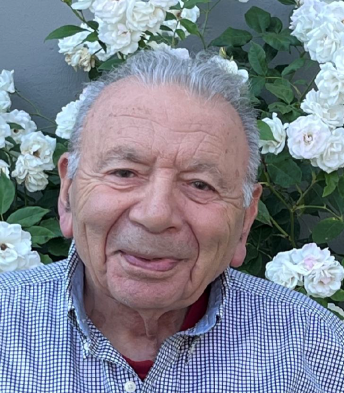
I was born in Damascus, Syria, in the year in which Hitler came to power.
Do I see in this coincidence a bad omen? I say so now, because I have become at the end of my life a destroyer of the Christian belief in Jesus Christ, Son of God. But I’ll let you judge by yourself.
On my father’s side I was Armenian Catholic. On my mother’s side I was Melkite Catholic. When we went to the Armenian church, mass was said mostly in Armenian with some parts in Arabic. When we went to the Melkite church, mass was said mostly in Arabic with some parts in Greek.
When I was eleven, I was sent with my younger brother, Pierrot, to boarding school in Beirut. The school was run by the French Jesuits. The day began with a 6 o’clock mass that was said in Latin. I did not know then that I was going to become a priest and study all those languages in order to be able to say mass in three different rites.
My mom was Beirut educated. She believed in the superiority of the education that was offered in catholic schools in Lebanon.
My paternal grandpa was a tailor. My older uncle learned the trade from him. But his younger brothers expanded the family business into an import business. Every year one of them would go to Europe and buy fabric closeouts. Their main sources were in Northern France (Roubaix-Tourcoing) and central England (Leeds-Manchester). Most of their business contacts were Jewish who specialized in the closeout business. In England, many of them spoke French and a few even Arabic.
Those trips took about three months. They would sail from Beirut to Marseille, then go by train to Paris. My mom used to go to Paris with my dad when we were below school age. She would stay there while he went on his shopping trips. We stayed at her parents’ place. They had purchased a city block at the edge of Damascus. Her three brothers lived and worked there. They manufactured silk fabric. They used for their designs a primitive form of computer invented by Jacquard in Lyon, France. Many years later, when I was studying theology in Lyon, my younger uncle would come and visit. His trips to Lyon became a form of pilgrimage. He played the piano. When his dad was young, he used to go to Cairo for the opera season.
I kept very fond memories of Damascus. But it was enriching to discover a very different world in Beirut. Lebanon and Syria were at that time under French protectorate. But the French presence in Beirut was more spectacular. Commencement – that is to say the beginning of the school year – was celebrated with panache. The Sunni Prime Minister and the atheist French Commander had to attend a high mass. The foreign legion (mostly black soldiers from Senegal) came on horseback. The streets were sanded. A large band played the usual loud music. I had never seen anything like that. I remember that the Senegalese soldiers did not attend mass. I saw some of them relief themselves on the wall of the brand new building of the Bibliothèque Orientale.
The French government was anticlerical in France, but collaborated with religious organizations overseas. So when the war ended in 45, young men who had graduated from college could avoid the military draft if they served for two years as teachers in foreign countries. Thus we had a steady flow of young blood. They were eager to discover the Middle East and they organized field trips to ancient Crusaders’ strongholds in Lebanon and Syria. We travelled cheap. We camped and cooked our meals. In my last two high school years two-month trips were organized to Europe during the summer. The purpose of those trips was to introduce us to European social institutions. Such institutions did not exist in the Middle East.
In the first trip, we concentrated on France. I worked as a camp councilor in Northern Brittany for delinquent boys. And I worked for two weeks in a cookie factory in Grenoble. We came back through the Swiss Alps and Italy and we sailed back to Beirut from Naples. The second year we discovered Northern Europe - Belgium, Holland, Denmark, Sweden and Norway. I worked in a brewery in Brussels. We learned about dairy cooperatives in Denmark and forestry in Sweden.
I was planning on going to architecture school. But at the last minute I changed my mind and decided to join the Jesuit Order. I spent 18 years in the Order. Everything went well until I became a priest. I hated hearing confessions, because I kept hearing about ladies’ problem with contraception. I disagreed with the Church on that point. My decision to quit the priesthood and the Jesuit Order was combined with the desire to get married. This was the most difficult decision of my life.
I have two children, Mike and Renee. By the time this book is published I’ll have three grandchildren. This book is my last child. My religious legacy is summed up in it. Many will hate me for it. But this is the best I can do in this highly sensitive field.
The years I spent in the Jesuit Order were enriching. Because I was born in the Armenian Catholic Church I had to say mass in Armenian. But first I had to learn the language. I did so in Aleppo, Syria. I spent three years teaching Arabic and French at an Armenian school there. At the same time I learned Armenian.
I studied many things in France for 8 years. I spend a few summer vacations in neighboring countries learning languages (English in London, Italian in Northern Italy and German in Bavaria and West Berlin). But my greatest achievement was a sound understanding of the Christian faith in Jesus Christ, Son of God. This was important, for when the time came to criticize the faith, I had to know what I was doing. That Jesus was human and divine at the same time is the basic claim of the old Christian Churches. But they did not agree on important technical points. The Armenian Church favored the views of Cyril of Alexandria who spoke of one nature, but Rome preferred to speak of two natures. I started thinking that this old dispute made no sense in the Twentieth Century. The crucial question, according to me, was the deification of Jesus in a Jewish context. How could that happen? How could a pagan view infiltrate Judaism?
My superiors wanted me to take over the Chair of Armenian Studies at Saint Joseph University in Beirut. But I gradually lost interest in this venture. Finally a happy encounter with a young lady tipped the scale. I got married and quit the priesthood.
I had a hard time adjusting to ordinary life and new responsibilities. I was a bad provider. After 10 years, my marriage fell apart. If you want to know more about my weaknesses, you should ask Mike and Renee. They are better judges than me.
I never met Michel de Certeau when I was in France. I kept missing him. When I arrived in Laval, he had left three months earlier. When I arrived in Chantilly, he had left a year before. I never met him in Lyon. He was in Paris. I discovered his writings after I arrived in Seattle. Without him I would have never learned about repressed memories and return of the repressed. This allowed me to discover in the Gospel of Mark what he had not discovered. Had he made that connection, he would have made my discovery useless. I owe him a lot. He introduced me to Freud and he gave me the tools that were needed to discover what I have discovered. He spent a few years teaching French literature (not his specialty) at UCSD. (My son went there for his bachelor degree). I came to America for a similar reason. I wanted to put some distance between me and my social environment. America is the land of the free. I owe her my intellectual freedom.
Seattle, October 20, 2026